Do you wake up in the morning with a dull, throbbing headache, a tired or sore jaw, or unexplained tooth sensitivity when sipping your morning coffee? If so, you may be experiencing bruxism—the involuntary clenching, gnashing, or grinding of your teeth while you sleep.
Because bruxism occurs unconsciously during deep sleep stages, many patients have no idea they do it until significant dental damage or jaw dysfunction appears.
At Westlake Family Dentistry, we help patients across Austin and Westlake Hills protect their natural teeth and alleviate chronic facial tension with precision-crafted, custom nightguards. Here is why nighttime grinding happens, the hidden toll it takes on your smile, and why an over-the-counter guard often does more harm than good.
What Causes Sleep Bruxism?
Sleep bruxism is a multifaceted condition often connected to modern lifestyle factors, stress, and neuromuscular mechanics. Common contributing factors include:
-
Chronic Stress & Anxiety: Elevated cortisol and daytime tension frequently manifest as unconscious nighttime jaw clenching.
-
Bite Misalignment (Malocclusion): When upper and lower teeth do not fit together harmoniously, the masticatory muscles overcompensate by grinding in search of a stable resting point.
-
Sleep-Disordered Breathing & Sleep Apnea: When airways narrow or collapse during sleep, the brain activates jaw muscles to thrust the mandible forward and reopen the airway, resulting in grinding.
-
Caffeine, Alcohol, and Certain Medications: High caffeine consumption or selective serotonin reuptake inhibitors (SSRIs) can alter sleep cycles and increase muscle hyperactivity.
The Hidden Consequences of Untreated Grinding
Human jaw muscles can generate between 200 and 250 pounds of force per square inch during waking hours—and during involuntary nighttime clenching, that pressure can spike even higher. Over time, unaddressed bruxism leads to serious oral complications:
[ Chronic Nocturnal Pressure ]
               │
               ▼
 ┌───────────────────────────┬───────────────────────────┬───────────────────────────┐
 ▼                           ▼                           ▼                           ▼
[ Enamel Attrition ]       [ Structural Fractures ]     [ TMJ Joint Strain ]        [ Gum Recession ]
Teeth flatten, shorten,     Micro-cracks in enamel;      Jaw clicking, popping,      Flexing at gum line triggers
and expose yellow dentin    broken crowns & fillings     stiffness, and migraines    abfractions and sensitivity
-
Premature Enamel Attrition: Grinding wears down protective enamel, flattening natural tooth cusps and leaving teeth looking short, uneven, and prematurely aged.
-
Dentin Exposure & Hypersensitivity: As enamel thins, the underlying porous dentin is exposed, causing sharp pain when consuming hot, cold, or acidic foods.
-
Broken Restorations & Cracked Teeth: Heavy bite force fractures crowns, dislodges composite fillings, and can split natural tooth roots, necessitating extractions and implants.
-
TMJ Disorders & Facial Pain: The temporomandibular joints (TMJs) on either side of your head become chronically inflamed, causing joint clicking, locked jaw, earaches, and chronic morning tension headaches.
Custom Dental Nightguards vs. Store-Bought “Boil-and-Bite” Trays
When patients notice clenching symptoms, many turn to cheap, over-the-counter nightguards from the drugstore. However, commercial guards present significant clinical risks:
| Factor | Custom-Fit Clinical Nightguard | Store-Bought “Boil-and-Bite” Guard |
| Material Quality | High-density, medical-grade dual laminate or acrylic | Soft, spongy, porous plastic |
| Bite Calibration | Balanced precisely to your individual bite and jaw trajectory | Bulky, generic fit with uncalibrated contact points |
| Chewing Reflex | Smooth, hard outer surface discourages muscle engagement | Soft, rubbery texture often triggers a “chew toy” reflex, worsening clenching |
| Bite Shifts | Stabilizes teeth in their correct, neutral position | Can shift teeth and cause irreversible bite changes (open bite) |
| Durability | Lasts 3 to 7+ years depending on grinding severity | Breaks or tears within weeks to months |
How We Fabricate Your Custom Nightguard
Getting a custom nightguard at Westlake Family Dentistry is quick, completely non-invasive, and comfortable:
-
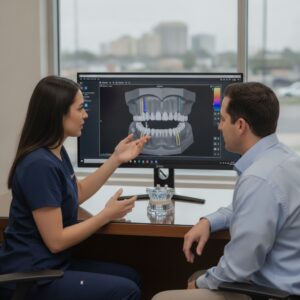
Digital Impression: Using high-precision intraoral digital scanning, we create an exact 3D virtual replica of your upper and lower arches—no messy, goopy putty trays required.
-
Laboratory Customization: A specialized dental laboratory fabricates your nightguard using a durable, dual-laminate material: soft on the inside for optimal tooth comfort, and firm on the outside to absorb bite pressure and allow your jaw to glide smoothly.
-
Custom Fit & Occlusal Delivery: When your guard arrives, we verify the fit in our office, adjusting the contact points to ensure balanced forces and zero pinch points.
Restore Restful Sleep and Protect Your Smile
Don’t let nocturnal grinding wear away your healthy tooth structure or cause chronic facial discomfort. A custom nightguard is a simple, non-invasive barrier that protects your smile investment for years to come.
Schedule your bruxism evaluation with the caring team at Westlake Family Dentistry today:
-
Location: Westlake Hills, TX
-
Phone: (512) 328-0155
-
Book Online: Schedule an Appointment at Westlake Family Dentistry